Total Pageviews

Showing posts with label Katniss. Show all posts

Thursday, April 12, 2012

Psychology in Hunger Games

     The Hunger Games, by Suzanne Collins, was undoubtedly an exciting novel with action-packed adventure, but I have focused more on a perspective that many others may have not.  When reading this novel for my book quest, through all the different twists and turns that the story took I felt there was a very prominent aspect of psychology within the games.  There were many instances in which the characters were forced to make decisions in the game that often entailed very positive or negative consequences.  The many factors and motives that went into the characters' decision making led me to my emphasis on the field of psychology and various mind games.
Katniss and Peeta
     A very common theme throughout the Hunger Games was the obvious connection between Katniss and Peeta.  Prior to the games even beginning though, Katniss was immediately faced with the obstacle of being selected alongside Peeta, who had previously saved Katniss' life when they were children.  Katniss felt like she owed him, yet she was now expected to kill him in the games which really forced her into a dilemma.  By the end of the games, Katniss and Peeta were the only two left.  It seemed as if it was now inevitable that one of them had to die now that the newly established rule of same-district winners had been revoked and it was secretly the plan of the Gamemakers all along.
    This was a prominent point in the book that facilitated my focus on mind games that the characters had been a part of.  With the devotion to her love for Peeta, Katniss comes up with the brilliant plan for them eat the poisonous berries together and then pretend to be deeply in love with Peeta in order to both be declared winners and not be held accountable for their actions.  With stunning acting, the both pull it off and convince everyone that they are truly in love.  This both has an affect on the audience and spectators of the games as well as Katniss herself.  They had now escaped their biggest problem and most importantly death, but now Katniss was unsure if Peeta actually had a real love for her.  This was just another instance of how manipulative the characters were throughout the development of the Hunger Games.
     A very interesting speaker we had in our class that always stands out in my mind was Stephen Garcia who lectured about psychology of competition.  The struggle between Katniss and Peeta as well as their focus on winning the Hunger Games was a situation where psychology played a major role.  One of the main concepts he expressed that was very evident throughout the book was social facilitation.  This concept states that competition and motivation on a given task increases when you work in pairs or small groups as opposed to alone.  This can be exemplified by the many alliance realignments such as Katniss' alliance with Rue and the on-and-off alliance with Peeta.  I can agree with this with first-hand experience that working together with someone is always more tempting.  It gives you a sense of reassurance when you think may be incapable of reaching your goal, ultimately providing more motivation.  Additionally, Dr. Garcia discussed the role of situational factors on competition.  Such examples included time, resources, and perhaps even the role of love, which all can profoundly impact the course of a game like it did in this book.  With the scarcity of food and supplies as well as the relationship between Katniss and Peeta, the level of competition in the games were without a doubt altered.  The love Katniss and Peeta may have had for each other completely changed the course of the game as an alliance between the two may never have even existed.  As far as I see it, the Hunger Games would have been a completely different story without the various psychological factors that were clearly put in play.
     I believe my understanding of the Hunger Games was enhanced by my prior knowledge surrounding the psychology that goes into competition and games.  It offered me a perspective on this story that probably would not have even crossed my mind.  Rather than simply following the storyline and plot, I was able to pick apart the motives and psychological mechanisms of the characters.  Katniss' love for Peeta as well as the strategy going into the various alliances formed contributed to my complete comprehension of the story, The Hunger Games by Suzanne Collins.

Monday, April 2, 2012

The Hunger Games and Ancient Rome

Spoiler Alert: contains key plot points from The Hunger Games Trilogy


http://www.jensc.org/wp-content/uploads/2012/01/HG2.jpg
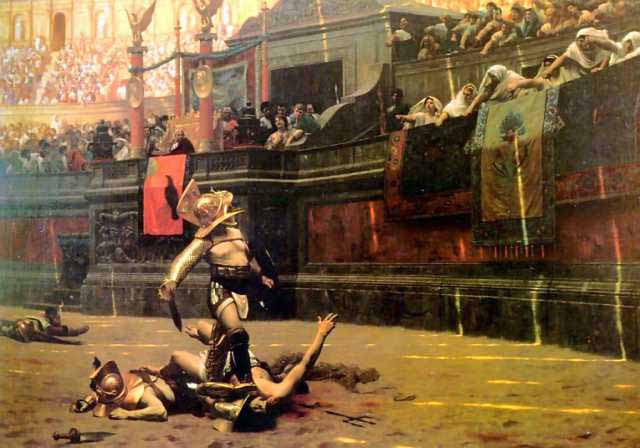
One of the things I noticed while reading The Hunger Games Trilogy was the numerous ways in which the Capitol resembles ancient Rome, probably the most obvious being the gladiatorial like games that they hold for both the punishment of the defeated and for their own entertainment.  However, the resemblance goes much deeper than this.
Something that struck me almost immediately was the first names of the Capitol's citizens: Cinna, Caesar, Plutarch, Flavius, Octavia, Venia, to name a few.  The first name of every person from the Capitol is a traditional Roman name.  I decided that the author, Suzanne Collins, was purposely trying to create a connection in the minds of her readers between the Capitol and ancient Rome, and so I began searching for more similarities.
http://thehungergames.wikia.com
I then realized that both ancient Rome and the Capitol had penchants for excessive wealth that they relied entirely on their providences/Districts to provide.  A very specific example occurs in Catching Fire when Katniss is disgusted by the Capitol practice of making oneself puke at a dinner party in order to make room for more food.  The Romans also indulged in this disgusting habit.  I later discovered in Mockingjay, that Plutarch directly compares the conditions in the Capitol to the 'Bread and Circuses' of Rome.
There is also an interesting correlation between President Coriolanus Snow and the emperors of ancient Rome.  In ancient Rome, the emperors often gained and held power by whatever means necessary.  In Mockingjay, Finnick Odair reveals the brutal tactics that Snow used in his ascension to power, including a Roman favorite, poison.  Readers are treated first hand to the threats, torture, and executions Snow uses to maintain his position.
There exist many more examples I could point out but instead I'll ask a question.  Why is Suzanne Collins making these comparisons between the Capitol and an ancient civilization from thousands of years ago?  In Mockingjay, Plutarch mentions that Panem had once been a republic, another quality it shares with Rome.  Now think of the implications when considering that in the first book, Katniss relates that Panem was once known as North America.
http://www.crystalinks.com/romerecreation.html
Carl Becker stated in Everyman his own Historian, "to be prepared for what is coming to us it is necessary not only to recall certain past events but to anticipate the future."  I think Suzanne Collins trying to use her vision of a dystopian future to warn us that we need to learn from the mistakes of the past.  This is why she ends The Hunger Games Trilogy with Plutarch's expression of hope that the people of Panem will learn from their recent history.


Thursday, March 22, 2012

Starving Myself from The Hunger Games

The Midnight Premiere of The Hunger Games is officially only 23 hours away, and just like any other person who has read The Hunger Games I am dying to see the movie...so why am I going to wait?

Right now I am currently in the middle of the second book Catching Fire. This book is amazing and I envision all of the scenes as if I were there. I have images in my head for Katniss, Gale, Peeta, Haymitch, President Snow, the Capitol, District 12, Katniss' home, the rebellions...all of it! I am enjoying this book so much that I actually don't want it to end! However, I won't let myself see the movie until I am finished with the complete trilogy.

I love keeping the images I have in my head of everything Hunger Games related. When reading the books, I like to have my own vision of this atmosphere, which is not yet affected by any third-party visions of the same story. Therefore, I have been trying to steer clear of all Hunger Games related publicity including all trailers, magazine articles, and news-related stories. Trust me...this task has been very difficult. It really seems as if The Hunger Games talk is permeating and ever-present; discussion of this movie comes up on TV, on Facebook, on websites, and in conversations with my friends. However, no matter how difficult it may be, I am on a mission to avoid all images of this movie until I am absolutely finished with The Hunger Games trilogy. This may be a daunting challenge, but I won't let anything get in the way of my vision of Katniss and her world.

So while everyone is off seeing The Hunger Games, I will be off somewhere playing my own game...avoiding this movie at all costs!

What do you all think about this task? Do you like completing a book before you see a movie to keep your own personal visions of the story? Or instead do you not mind having the images of the movie mix with your own imaginations of the same story?