Total Pageviews

Showing posts with label Games. Show all posts

Monday, April 2, 2012

The Hunger Games and Ancient Rome

Spoiler Alert: contains key plot points from The Hunger Games Trilogy


http://www.jensc.org/wp-content/uploads/2012/01/HG2.jpg
One of the things I noticed while reading The Hunger Games Trilogy was the numerous ways in which the Capitol resembles ancient Rome, probably the most obvious being the gladiatorial like games that they hold for both the punishment of the defeated and for their own entertainment.  However, the resemblance goes much deeper than this.
Something that struck me almost immediately was the first names of the Capitol's citizens: Cinna, Caesar, Plutarch, Flavius, Octavia, Venia, to name a few.  The first name of every person from the Capitol is a traditional Roman name.  I decided that the author, Suzanne Collins, was purposely trying to create a connection in the minds of her readers between the Capitol and ancient Rome, and so I began searching for more similarities.
http://thehungergames.wikia.com
I then realized that both ancient Rome and the Capitol had penchants for excessive wealth that they relied entirely on their providences/Districts to provide.  A very specific example occurs in Catching Fire when Katniss is disgusted by the Capitol practice of making oneself puke at a dinner party in order to make room for more food.  The Romans also indulged in this disgusting habit.  I later discovered in Mockingjay, that Plutarch directly compares the conditions in the Capitol to the 'Bread and Circuses' of Rome.
There is also an interesting correlation between President Coriolanus Snow and the emperors of ancient Rome.  In ancient Rome, the emperors often gained and held power by whatever means necessary.  In Mockingjay, Finnick Odair reveals the brutal tactics that Snow used in his ascension to power, including a Roman favorite, poison.  Readers are treated first hand to the threats, torture, and executions Snow uses to maintain his position.
There exist many more examples I could point out but instead I'll ask a question.  Why is Suzanne Collins making these comparisons between the Capitol and an ancient civilization from thousands of years ago?  In Mockingjay, Plutarch mentions that Panem had once been a republic, another quality it shares with Rome.  Now think of the implications when considering that in the first book, Katniss relates that Panem was once known as North America.
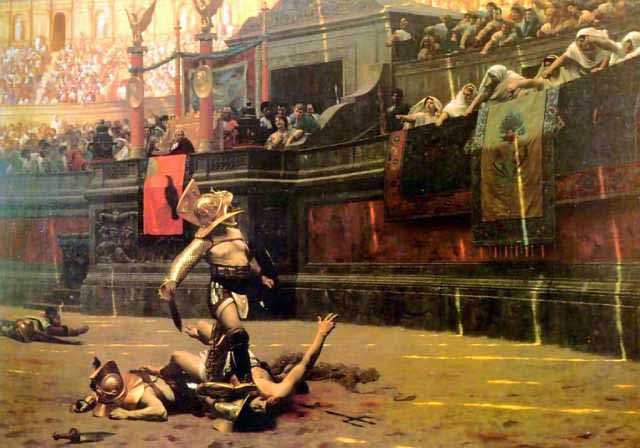
http://www.crystalinks.com/romerecreation.html
Carl Becker stated in Everyman his own Historian, "to be prepared for what is coming to us it is necessary not only to recall certain past events but to anticipate the future."  I think Suzanne Collins trying to use her vision of a dystopian future to warn us that we need to learn from the mistakes of the past.  This is why she ends The Hunger Games Trilogy with Plutarch's expression of hope that the people of Panem will learn from their recent history.


Monday, March 5, 2012

Are Games all Fun?


Who decides what is a game and what is not a game?  Since I was very young, my notion of a game was a fun, harmless, fictional realm in which there were set rules and an ending with some desired reward.  However, as I get older I am exposed to more serious and less fictional "games."  What happens when a fictional game is brought into real life and is no longer harmless?  Is this still considered a game?  As seen in The Hunger Games as well as a recent Law and Order: SVU, there is evidence of games in which the human life is at risk.

In The Hunger Games, representatives from each district are competing in a televised competition for survival.  The rules state that there can only be one winner, forcing all participants to rambunctiously kill all others in the game.  This "game" is neither fictional, fun, nor harmless.  It threatens the lives of all participants.  Similarly, in the episode of Law and Order: SVU called Hunting Ground, a man kidnaps women and plays a "game" with them.  He directly states the rules of the game in that each woman must act as an animal and be waited to be hunted by him and his gun.  In a dense forest, he searches for each woman and kills them.  He tells each participant that the only way to win the "game" is to die.  Based on these two similar life-threatening "games", my concept of what a game is has drastically changed.  I no longer think of it as a childish activity that is fun and harmless.  I now know that games come in many different forms, including ones in which death is the ultimate prize.

Wednesday, February 29, 2012

Perspectives on Drug Testing in Athletics

www.icassp2006.org
On February 17th, I attended an international sports law symposium hosted by the Michigan Sports Law Society.  For one of the topics, Howard Jacobs, one of the leading athlete’s lawyers in the United States, and William Bock III, who has served as General Council to the United States Anti-Doping Agency (USADA) since 2007, discussed their perspectives on drug testing in athletics.  Both agreed that doping in order to increase athletic performance should be considered cheating, but they disagreed over the ways in which USADA handles drug testing and prosecution of those athletes who test positive.

Mr. Bock opened by discussing the difficulty of actually catching dopers.  He used as an example a blog that tells dopers how to avoid testing positive.  He also showed how athletes could use extremely complex and exact routines that involve ingesting huge amounts of chemicals to avoid detection.  However, these detection avoidance routines involve a lot of money too.  As a consequence, the athletes that actually get caught doping are usually just the ones who can’t afford the extensive lab work and expensive physicians that these complex routines require.  Another consequence is that just because an athlete never tested positive for steroids doesn’t mean he or she never used them.

Mr. Jacobs argued that current testing results in too many false positives.  He believes that substances other than steroids or accidental consumption cause the majority of positives in drug tests, citing problems such as the notoriously bad quality control in the supplement industry and the general athlete attitude, ‘I’m not taking illicit substances, so I don’t have to worry.’  USADA spends too much money prosecuting these false positives when it should be spending its money developing more accurate drug tests.

If an athlete tests positive, the burden then lies with the athlete to prove their innocence.  Then, even if the athlete shows that the positive was caused by, for example, accidental consumption of a substance through a contaminated supplement, he or she is still penalized, though less so than an intentional doper.  Does this seem right?  Mr. Bock argued that some of these excuses are ‘dog ate the homework’ excuses.  Also, even if an athlete accidentally consumed a substance they still might be receiving its illicit benefits.  Is USADA going about its drug testing and prosecution the right way? 

Friday, February 24, 2012

Play AND Learn?


Every kid engages in several different games, whether it be by themselves or with other children around them.  My personal favorites were the game of LIFE, Guess Who?, Twister, and Chutes and Ladders.  These games all have set rules and are common among all childhood cultures in the United States.  As we learned in class, there are many benefits to children participating in these games.  Increased math skills and problem skills are among the most important.  I wonder where I would be if I never played these games.  Would I have liked math as much as I do? Would I have the same problem solving skills as I do now? And would my intelligence be at the level it is today allowing me to still be attending the University of Michigan? I never realized how much of an influence moving up and down ladders on a board game or simulating real life with game pieces would have on my life.  Because games are critical for a child’s development, most children play.  I find it unique that regardless of the environments in which we live, there is a shared “children’s culture” that is common among all kids.

Thursday, February 16, 2012

Make Love, Not Warcraft

This is a clip from the South Park episode "Make Love Not Warcraft" when the characters use their avatars to first go inside the game of World of Warcraft. I think that this clip is very relevant to our class discussion today about choosing your own avatar and how it relates to one's sense of self. Additionally, this clip is an example of Murphy's idea of Media Convergence. 

This episode is an example of different forms of media converging as the makers of South Park and Blizzard Entertainment were able to combine the media of television and video games in order to create a new medium. The medium of television plays on the medium of video games by literally incorporating real game footage into the episode. 

Therefore, this episode of South Park is a good example of how avatars play into gaming culture and how new media remediates older media as well.

Wednesday, February 15, 2012

A Second Life in a Virtual World

I have heard of Second Life, but have never played it before so when making an avatar was part of our homework assignment I was very interested in finding out more as to what Second Life was all about.

My original avatar
The vampire version of my avatar

Like the title, Second Life actually is a "second life" where your avatar can socialize and interact with other characters in an online virtual world. In this role-playing game, you can easily direct your character to interact with the other users simultaneously playing this game.


My avatar interacting in the world of Second Life

The well-designed graphics of the game
 make it interesting and entertaining

The arrows in the game direct players where to go

Although I previously had no idea how people could get into a game such as this, after playing it for a few minutes, I was easily able to find out how players could become captivated by Second Life. This game is literally a whole different world, but once you get the hang of the game maneuvers, it is actually quite simple and entertaining as well.

The chat feature allows the game to become extremely social and interactive

Thursday, February 9, 2012

Gamer: Is It Really a Game?


               I find it ironic that this movie begins with the song Sweet Dreams, as the future presented in Gamer seems much more like a nightmare.  In the movie, the future of videogames has arrived with gamers controlling real people instead of virtual characters.  Every movement or command of the gamer must be obeyed by his or her character because of mind controlling nano-cells implanted in the person’s brain.  There are two different types of games, Society and Slayers.
                       In Society, players can pay to control someone else or get paid to be controlled by someone else.  It’s basically a much lewder version of Second Life with real people.  Gamers can make their avatars socialize, go to raves, or engage in some kinky sex.  The movie also shows how the gamers use Society to take on new identities.  For example, a morbidly obese pervert uses a woman in racy attire as his avatar.  Of course, he doesn’t care because his fake identity hides the real him. 
                      
Society looks a lot like a Lady Gaga music video
                         In Slayers, gamers control death row inmates in Modern Warfare like death matches.  When a player dies, it is a real person getting killed.  Slayers’ creator defends the ‘game’ by arguing that the convicts volunteer willingly because they will be released if they can survive thirty matches.  So is it really a game?  Certainly not for the convicts themselves.  They may volunteer, but within the arena or ‘the magic circle’ they are little more than puppets. 
 My finally question is: can anything designed to take a human life really be considered a game?  What about games that can put human life at serious risk, such as mountain climbing or bull fighting?  What about Society, in which the gamers force their avatars to do terribly demeaning things?  Don’t games ultimately require fun and harmlessness as a fundamental part of their nature?

Wednesday, February 8, 2012

Do you have a Second Life?


For those of you who are not familiar with the virtual game, Second Life, let me explain. Second Life is a game that has introduced a unique virtual world. In this game, users have the ability to create an avatar of anything they can imagine, regardless of who they are in reality. According to its developers, Second Life is, "A place to connect, a place to shop, a place to work, a place to love, a place to explore, a place to be different, a be yourself...and a place to love your life." Second Life is a game that facilitates a world away from reality in which users explore a world unlike that of our own. By creating their own fantasies, hundreds-of-thousands of Second Life users have the ability to interact with individuals throughout the world and connect with them via their avatars. 
Boston's Financial District *E#494
Avatars Interacting Via Second Life
The first time I heard about Second Life was in 2010, when I watched the Sundance Film Festival documentary, Life 2.0. Made by documentary filmmaker, Jason Springarn-Koff, Life 2.0, explores the world of Second Life, and how it has transformed the lives of its users—not just in the virtual world, but in the real world as well. It is a game that is truly unlike any other I've ever seen. I, myself, have yet to play Second Life, but I am fully aware of the potential effects the game can have on its highly active users. I am curious as to how players perceive this game, and why they have become so entranced. 

We all have passions in life (real life); ambitions we seek and hope to achieve sooner rather than later. In Second Life, users have objectives as well. In both lifestyles, there are various paths for individuals (or avatars) to take. If a person (or avatar) is on the right course, he or she should pursue it. However, when it comes to direction, it is never too late for anyone (or anything) to change. Why spend so much time organizing your Second Life, when you have the potential to change your real life? Second Life is a game, and so is life—you can play it however you want.